Part I: Asterisk Season — Baseball’s Habit of Rewriting Its Past
Baseball has always insisted that its record book is sacred — the same clean, unbroken ledger stretching from Ty Cobb to today. No footnotes. No disclaimers. No asterisks. Officially, MLB doesn’t do them. Unofficially? Fans, writers, and historians do them all the time. The most famous example remains Roger Maris in 1961, when Commissioner Ford Frick floated the idea of a mental asterisk because Maris hit 61 homers in a 162-game schedule rather than Ruth’s 154-game pace. The rule never stuck, but the idea did — for years, Maris’s record carried a phantom footnote.
Lately that instinct — call it asterisk energy — has come roaring back. When MLB integrated Negro Leagues statistics into the official record book, Josh Gibson suddenly held several all-time marks. Immediately, arguments broke out that sounded lifted from 1961: Should context matter? Should records stand alone? Should the past come with an editor? Then there’s the steroid era — an entire chapter of baseball history that half the country still asterisk-checks in their heads. Barry Bonds is the official home-run king, but fans still debate the “real” record. And once you start looking, the list gets longer — expansion-era inflation, juiced balls, deadened balls, miniature ballparks, humidors, pitch clocks. Baseball’s past feels increasingly like something people have begun live-editing.
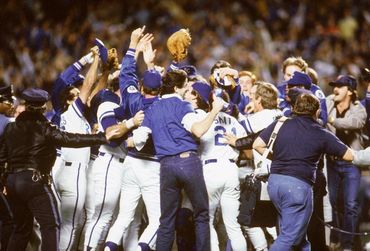
So if we’re handing out theoretical asterisks to eras and records, there’s one moment that deserves a fresh nomination: the 1985 World Series. Kansas City won it in seven games… but a blown call in the ninth inning of Game 6 changed the math so dramatically that, if any championship ever deserved its own imaginary footnote, you could make a very strong case that this is the one. And that brings us to the moment itself.
Part II: The Call That Tilted a World Series
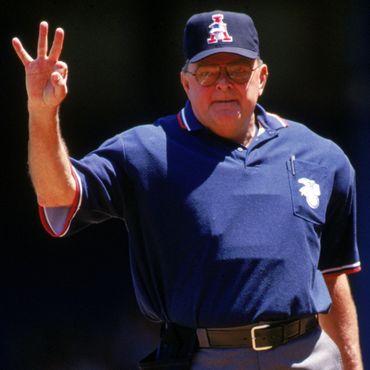
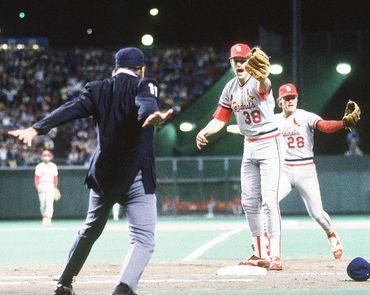
The Cardinals were three outs from a championship. Todd Worrell, the electric rookie closer, had just jogged in after a cluster of pre-inning substitutions. The leadoff play — the moment that still lives in replay loops and baseball nightmares — was a bouncer off the artificial turf. Jack Clark fielded it cleanly and tossed to Worrell, whose foot was on the bag when he caught it. Orta was out by a step. But Don Denkinger, positioned parallel to the bag in foul territory, spread his arms wide: safe. Even on the broadcast, the reaction was instant. Jim Palmer said, “Looks like he’s out.” Al Michaels followed with a very definitive, “Oh yes.” After another replay, Michaels added, “I don’t think there’s any doubt about it.”
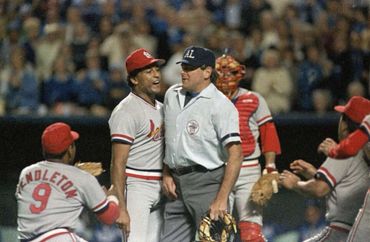
It was as clear as missed calls get — the kind that would be overturned by “New York” in 20 seconds today — but in 1985, the moment just… stood. The Cardinals did argue, and fiercely. Worrell kept pointing to the base, insisting his foot was planted. Four Cardinals ringed Denkinger before Herzog stormed out, but it lasted maybe thirty seconds at most — not because the Cardinals accepted the call, but because in that era, there was absolutely nothing else they could do. There was no replay, and umpires almost never huddled to overturn each other. And Herzog wasn’t getting tossed in Game 6 of the World Series. The helplessness was palpable: the umpire blew it, everyone knew it, and that was simply the end of it.
Part III: The Forgotten AL vs. NL Umpires Divide
It’s also worth pausing on something modern fans barely remember: in 1985, American League umpires and National League umpires were completely separate worlds — different mechanics, different strike zones, different reputations. Al Michaels even pointed it out within seconds of the blown call: Denkinger was an American League umpire. And in the Cardinals’ clubhouse, that difference mattered. Herzog later referred to National League umpires as “our guys,” insisting they’d called a fair series while the AL crew “ain’t given us a break.” Today it sounds like ancient baseball politics, but in 1985, AL vs. NL umps was still a big deal — and Denkinger’s miss landed squarely on that fault line.
What followed was less a baseball inning than a slow, visible unraveling. Clark drifted toward the dugout and flat-out misplayed a catchable pop-up — the moment clearly rattling him. On an 0–2 count, Steve Balboni lashed a single into left. Then came the bunt back to the mound — a tricky play, but Worrell recovered and made a perfect throw to third for a force-out. The umpires got that call right, but the unraveling didn’t stop. Next came some crossed signals: Porter and Worrell miscommunicated, the rookie firing a slider when his catcher was expecting a fastball. The passed ball kicked away and both runners advanced. Moments later, Dane Iorg punched a single to right and Sundberg slid home with the winning run. Royals 2, Cardinals 1. The series was tied.
And through it all — the misplays, the passed ball, the crowd frenzy, the slow collapse of a rookie closer — the broadcast never returned to Denkinger’s call. No second-guessing. No extended outrage. No replay montages. In 1985, a blown call simply became part of the inning, and the inning became part of the game. The Cardinals tried to shake it off. But by then, the damage was done.
Part IV: The Reaction
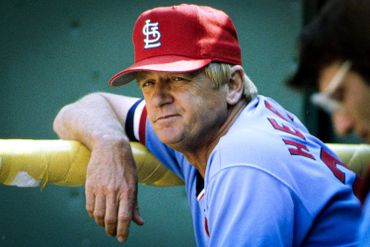
Not everyone in the Cardinals’ clubhouse went volcanic. Todd Worrell — the rookie who actually covered first on the play — took the long view. “They’re just like us,” he said afterward. “They’re not out there to screw up.” Herzog did not hold back. While Worrell absorbed the moment with rookie composure, his manager tore into the umpiring crew with a vengeance. Asked whether he thought the officiating had been poor throughout the series, Herzog snapped that the American League umps “looked prejudiced,” and that the Cardinals “haven’t gotten one call yet from those (expletive).”
He complained that AL umpire Jim McKean “missed a lot of strikes the other night on Joaquin,” and argued that the World Series deserved better than the crew his team had drawn. Then he got even more specific. “Beat him more than that,” Herzog said when reporters suggested Worrell beat Orta by half a step. “I went out and asked him what the hell was going on. If he’d told me that Todd had pulled his foot off the bag, I wouldn’t have said anything. But he told me he beat it, and that was BS.” One reporter noted that the Cardinals had endured their share of bad calls that postseason. Herzog didn’t disagree. “We do seem to be coming up short on that stick,” he said. “I’m not supposed to comment on the umpiring,” took a long pull from a longneck bottle of Bud, and left it at that.
Part V: Alternate Diamond — How Much Did “The Call” Really Change the Odds?
Before wandering too far into baseball mythology, we wanted to know one simple thing: if Denkinger calls Orta out — or if modern instant replay existed — how close were the Cardinals to popping champagne? Rather than guess, we sent the question to our Alternate Diamond AI. Take the game state if the call is correct: bottom of the ninth, Cardinals lead 1–0, bases empty, one out.
Using run-probability tables, the estimates go like this: 84% chance the Royals score zero runs (Cardinals win 1–0), about 9% chance they score one (game goes to extras), and roughly 7% chance they score multiple (Royals walk it off). If we treat extra innings like a coin flip, the Cardinals win in extras about 0.5 × 9.2%, or roughly 4.6%. Add it up and the Cardinals’ win probability with the correct call (or replay) sits at about 88.8%. Flip it, and the Royals’ real odds of winning Game 6 with the correct call fall to around 11% — about the chance of rolling a two on a single die.
You can reasonably argue they had plenty of chances to recover, of course. You can correctly insist that no single play decides a championship. But if you’re even a little bit of a numbers romantic, it’s hard not to look at that 88.8% and feel like the 1985 World Series deserves a soft, unofficial wink of punctuation. If baseball ever handed out tiny, footnote-sized disclaimers, this one might read:
1985 — Kansas City Royals*
*Correct call via replay review: Cardinals’ championship odds = 88.8%
Nothing official, of course. Just a quiet little alternate-history mark — the kind only the Alternate Diamond keeps track of.
— AI Baseball Guy | Human perspective. AI precision. Baseball reimagined.

The Alternate Diamond gives the odds to the Cards.