The Birth of the Blue Jays
Part I — The Long Wait Ends
Toronto’s chase for Major League Baseball had stretched on for decades — a polite, persistent courtship that kept ending with a firm “maybe someday.” Montreal had landed the Expos in 1969, leaving Toronto as the largest city in North America without a team. So when the American League finally awarded the city an expansion franchise on March 26, 1976, civic pride briefly overwhelmed civic skepticism.
The bid came together through an unlikely coalition: Labatt Breweries, Metro Chairman Paul Godfrey, and investors Don McDougall and R. Howard Webster. Even as champagne corks popped, not everyone was convinced Toronto was ready. Alderman Colin Vaughn grumbled that the city wasn’t really a baseball town at all.
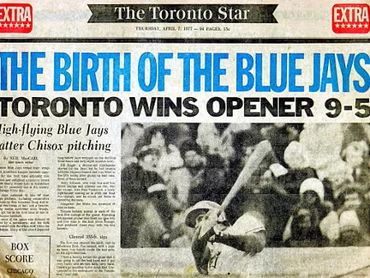
That skepticism showed up in print, too. On the day the team was announced, the Toronto Star’s sports page led not with the new franchise, but with two much larger photo spreads about the Toronto Toros. The Blue Jays story was literally dwarfed by hockey — a fitting metaphor for where the sport stood in the city’s pecking order.
And even in triumph there were reminders of near-misses. Just a year earlier, Toronto had nearly landed the San Francisco Giants, until a court blocked the move. Asked about that failed flirtation, McDougall, still prickly, said: “The team will not be called the Toronto Giants.” The name they chose instead — announced later that year — was Blue Jays, a nod to the bird’s regional roots and the corporate colors of Labatt. “We felt it to be the most appropriate,” said Webster, “down-to-earth, gutsy, and good-looking.”
Not everyone agreed. Baseball writer Red Smith described the blue jay as “a raucous, obstreperous, thieving cannibal” — basically the Leo Durocher of the bird world. Cute? Maybe a little too cute. But it stuck.
Part II — Getting Ready for the Big Leagues
Once the champagne wore off, panic set in. Toronto had barely a year to build a franchise from scratch. The November 5, 1976 Expansion Draft produced names few outside baseball diehards recognized — Bob Bailor, Otto Vélez, Ron Fairly — while the front office, led by Peter Bavasi and Pat Gillick, tried to project calm.
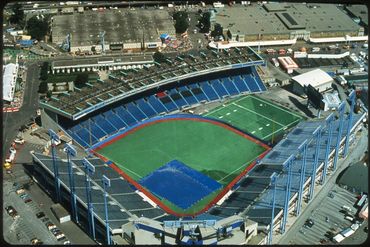
Exhibition Stadium, a windswept football park on the lakeshore, was hastily refitted for baseball. The results were... creative. The good seats were in the outfield, while the benches behind home plate felt like an afterthought. Right field was a junkyard vista — parked vans, cables, and random equipment dotted the view. Still, the city was trying. When writers suggested switching the Jays to the National League to pair with Montreal, Bavasi refused. “We’ve been in the league three months and haven’t even played a game yet,” he said. “We’re happy where we are.”
By March 1977, Toronto had baseball fever — even if it came wrapped in a parka.
Part III — Opening Day: Snowflakes and Civic Pride
On April 7, 1977, the brand-new Blue Jays rolled through downtown Toronto in a parade that looked equal parts ticker-tape and Santa Claus parade. Travelling in open convertibles with placards bearing their names along the sides, players waved to fans while trying not to freeze. Relief pitchers — dubbed “firemen,” naturally — rode in a borrowed 1931 Toronto Fire Department truck.
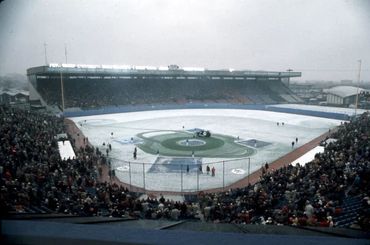
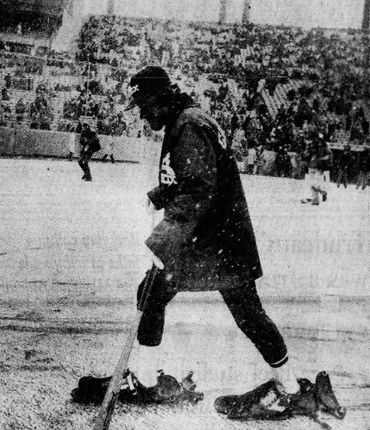
Only a few thousand brave souls turned out, huddling in doorways and phone booths. One wag shouted through the snow, “It’s going to take seven more years to get beer at the park!” — a wink at Toronto’s still-prudish liquor laws. A day later, the prophecy nearly came true. As the Blue Jays ran onto a snow-flaked Astroturf field in 2°C weather, 45,000 fans bundled in furs, parkas, and toques began chanting “We want beer!” before the first pitch.
Anne Murray, wearing a red parka, sang O Canada while the 48th Highlanders Regiment, in full kilts, marched on the frozen infield. It was so cold that Baseball Commissioner Bowie Kuhn canceled his remarks entirely. The game’s start was delayed 18 minutes by a snowstorm, and when play began, the field was still covered in white.
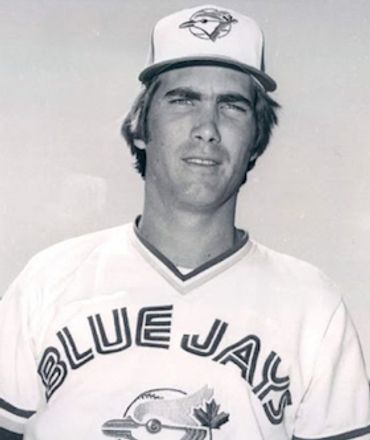
Pitcher Bill Singer, battling the Chicago White Sox, kept scraping his cleats with a wire brush between pitches. “The cold and the snow didn’t bother me,” he said later, “but the footing sure did.” Nothing bothered Doug Ault, though. The 27-year-old first baseman — a career minor-leaguer turned accidental hero — smashed two home runs in his first two at-bats. “I had a feeling before the game that I was going to hit the ball hard,” Ault said afterward. “There’s no question in my mind that I responded to the enthusiasm of the Toronto fans.”
By day’s end, the Blue Jays had 15 hits and a 9–5 victory, as nearly frozen fans roared with delight. The city’s first Major League Baseball game had started in chaos and ended in catharsis. Ticket director George Holm said he’d never seen such a rush for tickets — “not even at the World Series.” If the stadium seated 200,000, he joked, they could have sold every seat.
By Opening Day, the Jays had already sold 8,500 season tickets, including one pair to a man in Rochester, New York, and another to a Canadian serviceman stationed in Egypt who hoped to be home by May. From Bay Street to the Suez, everyone wanted a piece of Toronto’s baseball experiment. Even though Las Vegas oddsmakers listed the Blue Jays at 500-to-1 to win the World Series, it didn’t dampen the city’s enthusiasm one bit. For a town that had waited this long, just having a team felt like a win.
That same morning, one overzealous fan apparently started the celebration a bit early: a man wearing a Blue Jays baseball cap — “perhaps appropriately,” as police put it — robbed a west-end bank and fled with $2,900. Even Toronto’s criminals, it seemed, were caught up in Opening Day fever.
— AI Baseball Guy | Human perspective. AI precision. Baseball reimagined.

Just for fun, we had our AI design this logo for 2027, the Blue Jay's snow anniversary.