The Rise of Astroturf
Part I: The Game on Plastic
Nothing in baseball beats watching a game in one of the cathedrals — the hand-stitched charm of Fenway Park, the ivy calm of Wrigley Field, or the brick-and-steel perfection of Camden Yards and the ballparks that followed in its wake. They smell like grass and summer and the way the game ought to look.
But for some fans, there’s still a soft spot — maybe even a guilty one — for the old game that was played on turf.
Watch a National League East broadcast from the early 1980s — the Cardinals and Expos, or the Pirates and Phillies — and you’ll see a sport that looks almost alien beside today’s launch-angle era. The ball rockets off the carpet. Fielders move in fast-forward. Singles turn into doubles; doubles become triples. The whole game feels kinetic and improvisational, like pinball in cleats.
Nobody’s pining for the return of the stuff itself — the hard, heat-trapping plastic that could fry a shortstop’s shoes and make a high chopper feel like a trampoline test. Those cut-out infields and bouncy warning tracks were nobody’s idea of natural beauty. But what some fans do miss is the style of baseball that artificial turf created: all legs and hustle, daring base-running and bunts dropped just right. It was, in a way, a modern-day echo of the dead-ball era — a game of motion instead of muscle.
Players like Vince Coleman, Tim Raines, Ozzie Smith, and Pete Rose turned that bright green surface into a stage. They weren’t waiting for three-run homers; they were manufacturing runs, stealing them, stretching them, daring opponents to blink. The turf game made stars of sprinters and acrobats, and for a time it gave the National League a style all its own.
Watching in person at Three Rivers, Riverfront, or Veterans Stadium could be dreary — concrete bowls with cookie-cutter sightlines — but on television, in small doses, that version of baseball could be pure adrenaline. There’s something almost quaint about it now: an entire league reshaped by flooring.
And it all began, improbably enough, in a dome in Houston, Texas — with a dead lawn, a handful of chemists, and one owner who believed the future of baseball might just be plastic.
Part II: The Plastic Frontier
It started as a fix for dead grass — and became a revolution.
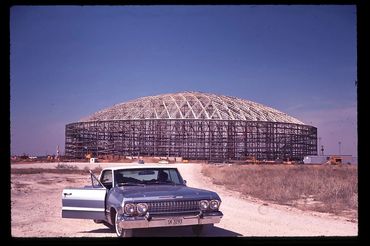
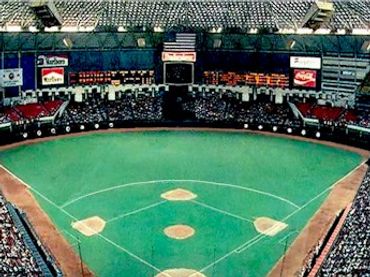
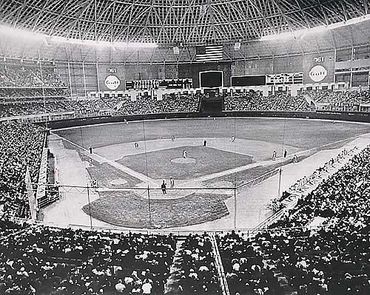
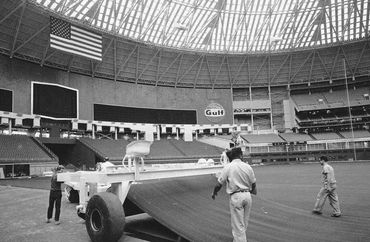
When the Houston Astrodome opened in 1965, it was billed as the Eighth Wonder of the World: baseball’s first indoor stadium, a monument to mid-century American ingenuity. The problem was that grass refused to grow under the Dome’s Plexiglas panels. When players complained about glare from the Texas sun, the panels were painted — and the grass promptly died. As one Houston Chronicle writer dryly noted, this was “a fact that even the simplest freshman biology student knows.”
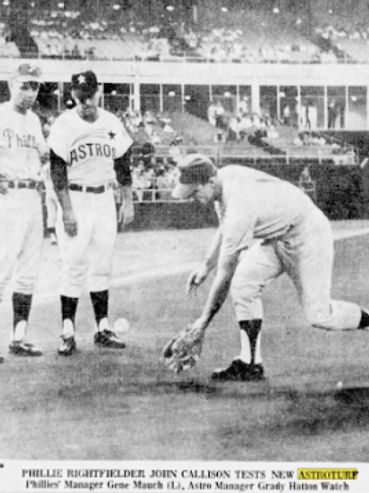
So the Astros’ showman-owner Judge Roy Hofheinz went looking for a miracle. He found it at Monsanto, where a Chemstrand division was experimenting with synthetic fibers for playgrounds. The result was Chemgrass, renamed AstroTurf — a moniker Hofheinz supposedly endorsed with his trademark salesman’s grin. “If I were you, I’d call it Chemturf,” he joked, “but go ahead — I won’t sue.”
Hofheinz even bragged that Chemstrand gave him “a better deal than the $2 a square foot you’d pay if you wanted it for your front lawn.” In a warehouse, crews were “zippering together” vast 14-foot-wide strips — some 221 feet long — like pieces of a giant puzzle. “It’s just like working a big jigsaw puzzle,” said Astros grounds chief Red Dozier, “but it’s going to be beautiful.”
True to his space-age flair, Hofheinz briefly considered painting the turf purple — or even making it three different colors: blue down the foul lines, red in the infield, and yellow in the outfield — before finally settling on a bright, greener-than-real-grass hue. Thank goodness he didn’t follow through; baseball in psychedelic Technicolor might have required sunglasses in the stands.
Still, Hofheinz couldn’t resist a joke about his new toy. “Who knows?” he said with a grin. “We might have this little button down in the Astro dugout. When the Houston club has an opponent that likes a fast infield, we could always speed it up for them.” It was said in jest — but it fit perfectly with the Dome’s giddy, space-age confidence that progress could be engineered on command.
And Hofheinz’s creation was already making headlines far beyond Houston. Before a single player had tested the turf, Astros business manager Spec Richardson received a collect call from Saudi Arabia — someone hoping to become the Near East agent for AstroTurf. Hofheinz just laughed: “Great idea, isn’t it?”
Part III: Strategic Speculation
Even before the first game, baseball men were trying to imagine how the sport itself might change. “Third-base coaches may need to adjust their thinking caps,” one reporter wrote, “simply because the ball will be getting to the outfield quicker.”
Coach Jim Busby warned, “It may be tougher to score from second base on a single, because the ball will get out there quicker than on grass. It might cut down on guys going from first to third. Of course, you have to play the ball a little deeper.”
Outfielders, meanwhile, were expected to guard the power alleys more carefully, ready for the new laser-like hops the surface would produce.
At the time, nobody seemed to question whether baseball should be played on plastic. In 1966, it was pure optimism — space-age progress at full throttle. Even Leo Durocher, never one to hide his opinions, grumbled that it was “a downright shame” to build a $31 million edifice and “ruin it by putting in that stuff,” but voices like his were the exception. For most, this was the future — and the future was shiny, seamless, and low-maintenance.
Part IV: Early Reactions — Shock, Curiosity, and a Little Bit of Awe
When the Astros finally played on full AstroTurf in 1966, the early consensus was confusion mixed with cautious approval. Some players shrugged that it didn’t make much difference; others said it felt “like carpet laid over concrete.”
But as columnist Wells Twombly put it, “those moss-backed reactionaries who play major league baseball did an incredible about-face.” Instead of denouncing the synthetic field as some kind of outlandish gimmick, “they couldn’t say enough pretty things about it.” The most old-school players in the game had suddenly gone space-age — if only for a night.
Philly manager Gene Mauch admitted the only real difference he noticed was that the outfield fence had been moved in — “and that killed us.” Dodgers first baseman Wes Parker even joked that “all they really need to make this the best infield in the National League is some synthetic dirt someplace.” It was still too new for anyone to predict how it would change the game. But one thing was clear: baseball’s first step onto plastic grass wasn’t just about science — it was about attitude.
Part V: The All-Turf Team
All this talk of the Astrodome and the space-age rise of artificial turf got us thinking: what would an all-time turf lineup look like?
To make the cut, a player had to meet two simple rules:
He played most of his prime years on an artificial surface.
He embodied the skills and spirit that turned turfball into its own brand of baseball — speed, precision, adaptability, and the courage to go full-tilt on a field that felt like a pool table in July.
So we asked our AI Skipper to draw up the lineup card — a team built for the bounce, the skip, and the chaos of the carpet.
- Willie Wilson (CF, Royals) — Baseball’s fastest blur on the carpet. No one covered more fluorescent green per inning.
- Tim Raines (LF, Expos) — Olympic Stadium’s jetway. Patience, burst, and base-path artistry — the most elegant turf technician of all.
- George Brett (3B, Royals) — The rare turf slugger. Line drives that hit and accelerated. He brought charisma and clout to the carpet era.
- Andre Dawson (RF, Expos) — Power and bruises. Montreal’s Hawk thrived in the hard-skid gaps and paid the physical price for it.
- Pete Rose (1B, Reds / Phillies / Expos) — He didn’t just play on turf; he defined the era. Head-first slides, 4,256 hits, and an engine that never quit.
- Ozzie Smith (SS, Cardinals) — The Wizard turned one-hop rockets into balletic theatre. Turfball’s defensive soul.
- Frank White (2B, Royals) — Grace and geometry at Kauffman Stadium — the infield general of Kansas City’s speed dynasty.
- Tony Peña (C, Pirates / Cardinals) — The spring-loaded catcher: low crouch and lightning release.
- Pitcher — Bob Gibson (Symbolic Pick) — Because intimidation still plays on any surface.
Bench: Vince Coleman, Willie McGee, Lenny Dykstra, Tony Fernandez, Jose Oquendo.
Sure, they wouldn’t hit the most home runs or win the launch-angle sweepstakes. But this team would steal you blind, take every extra base, and make every grounder an adventure. Maybe they’re not the best team of all time — but they’d sure fill the seats.
— AI Baseball Guy | Human perspective. AI precision. Baseball reimagined.

The Astrodome in Houston, Texas.